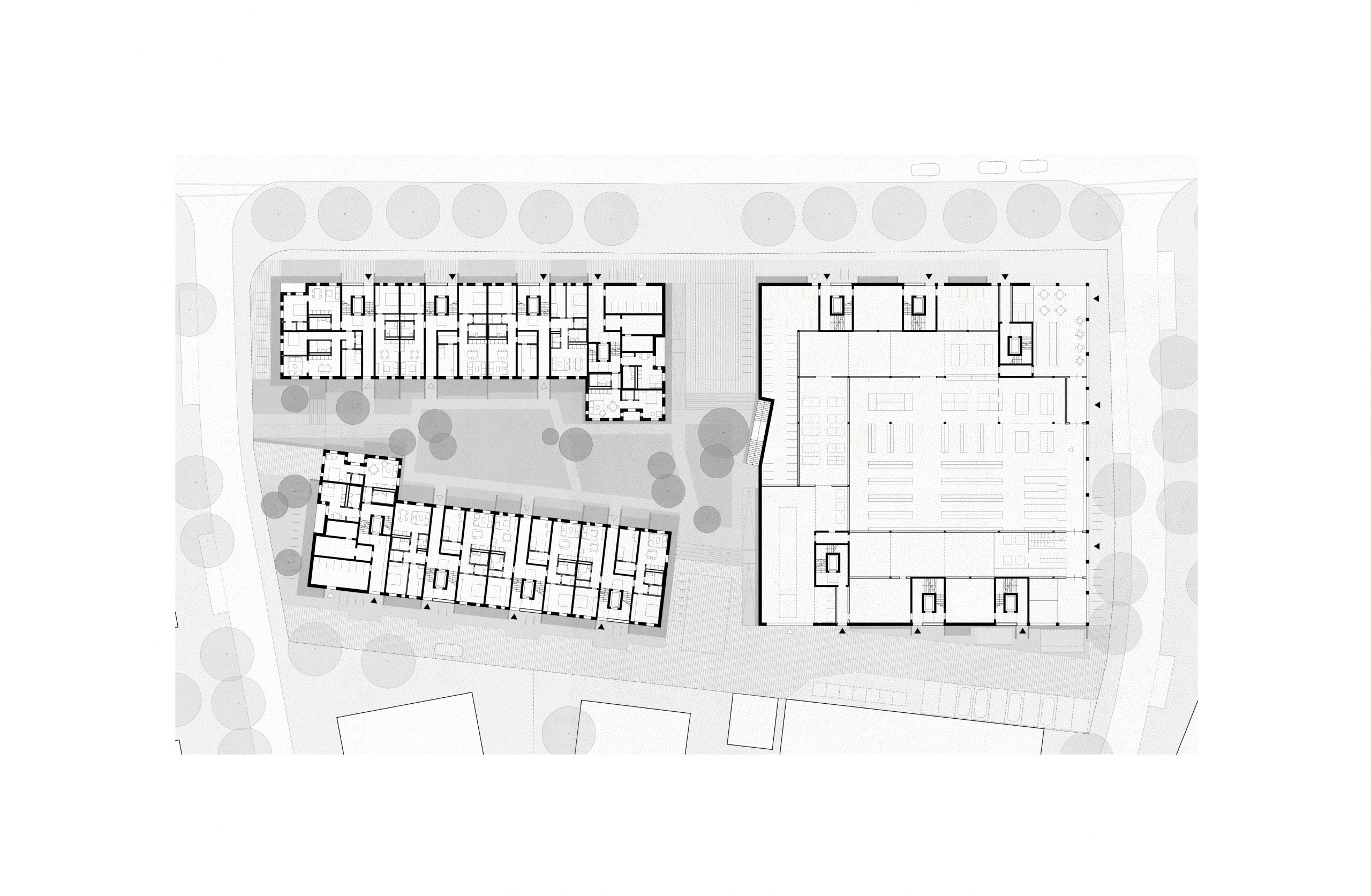
Our design for the »urban dot« is organized around a strong central space. It balances openness and protection, providing room for everyday amenities as well as for social exchange. The project supports neighborhood life in daily routines while offering places for privacy and retreat. Four clearly defined linear buildings frame a green center — the heart of the quarter, both functionally robust and atmospherically distinctive.
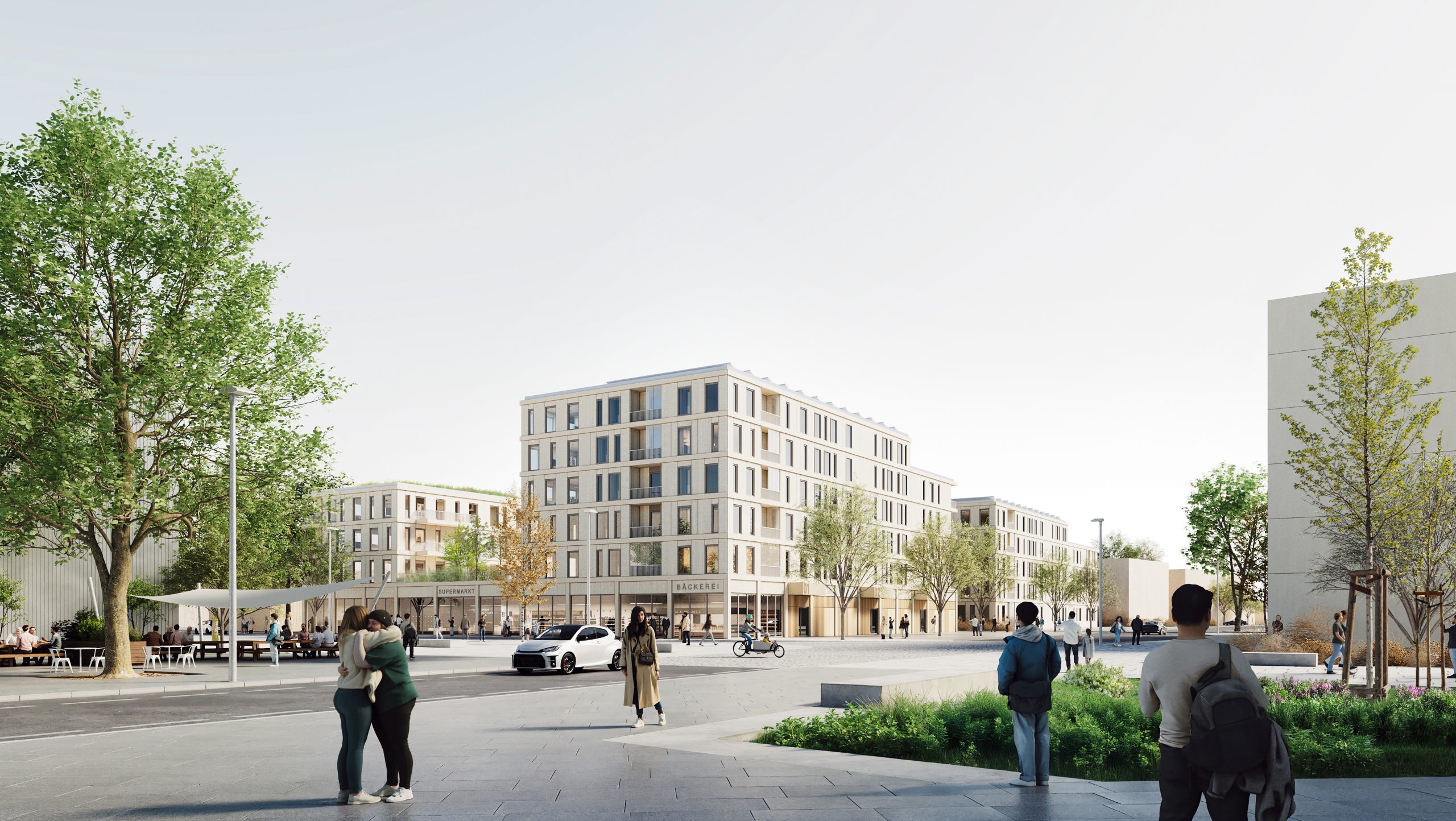
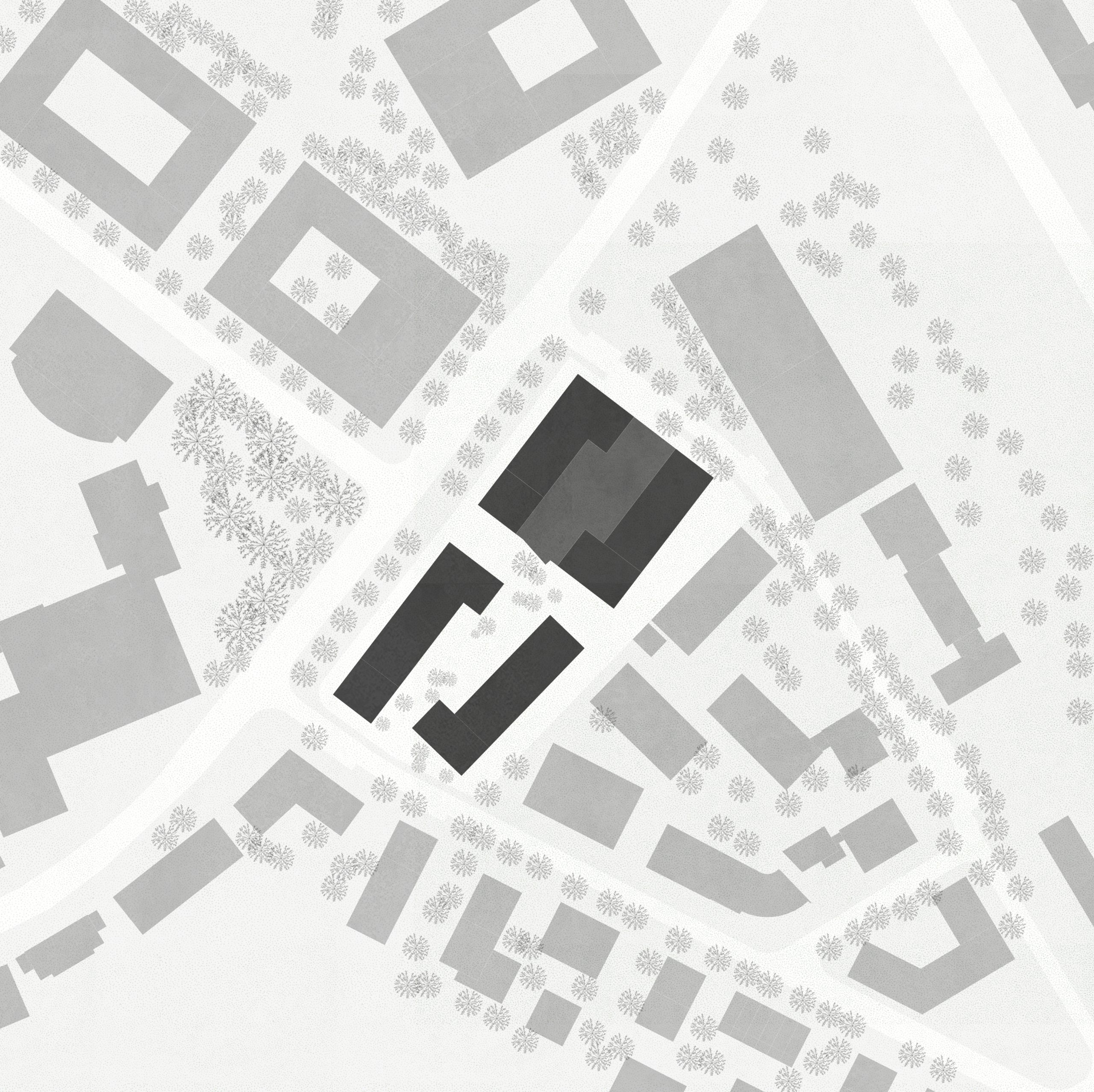
The design builds on the grain of the master plan and develops it further: instead of two isolated buildings, four interlocking linear blocks are formed, connected through their end buildings. This arrangement creates an elongated green common, sheltered from Dottendorfer Straße while remaining well ventilated and generously daylit. In terms of scale, the ensemble mediates between the dense perimeter block structure to the north and the more open residential fabric to the south. The end buildings articulate a stepped height profile and define clear addresses, while the supermarket, organized as an arcade, activates the neighborhood square and opens the site toward the city.
Between Everyday Life and Architectural Quality
At the heart of the »urban dot«, a new neighborhood supermarket is envisioned as part of a lively residential setting. The project seeks to seamlessly integrate living, daily shopping, and community life. Economic feasibility, urban coherence, and architectural quality are treated as equally essential parameters and together inform the design.
Clarity in the Grid, Diversity in Life
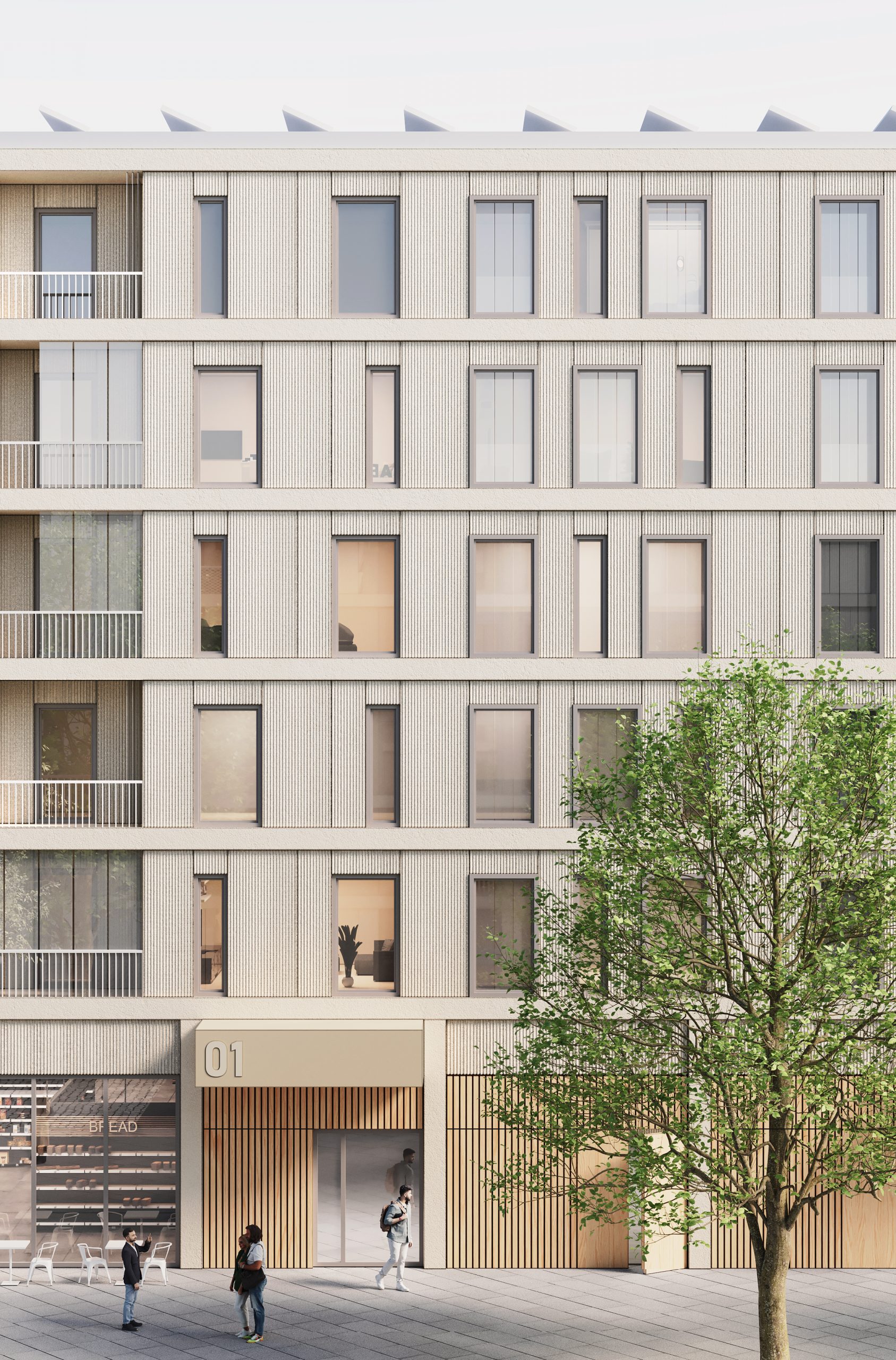
A rational structural framework provides clarity and efficiency, while diversity emerges through a mix of three housing typologies: market-rate apartments in the end buildings, subsidized housing within the linear blocks, and adaptable floor plans that allow for long-term flexibility. Externally articulated stair cores establish clear addresses; loggias offer quiet private outdoor spaces while also serving as acoustic buffers. The result is a broad spectrum of housing that balances public vitality with opportunities for retreat. The façades are composed in a consistent rhythm of horizontal bands, loggias, and textured rendered surfaces, with timber elements adding warmth and accentuating entrances.
The Green Lung of the Neighborhood
The central green space is the project’s connective core: a two-level common structured as a linear green, combining play areas, spaces for rest and relaxation, a rooftop garden, and a courtyard, all linked by a generous, sculptural stair. Semi-private forecourts provide a sense of intimacy, while expansive play and seating areas encourage social interaction. Noise is buffered, fresh air is drawn through the site, and the central space becomes the neighborhood’s green lung.
Beyond Technology – A Living Cycle
Compact building volumes and repeatable structural systems ensure efficient use of resources and economic viability. Photovoltaic arrays on the roofs generate on-site energy, while retention areas collect rainwater and contribute to cooling through evaporation. Green roofs and façades create habitats for flora and fauna, and permeable surfaces allow water and soil to remain part of a natural cycle. Sustainability here is understood not only as a technical strategy, but as a social one as well: open and active ground-floor uses, a café, and the supermarket strengthen everyday interaction and community life.
Location
Bonn
Type
Living
Client
WID R1 Bonn GmbH
Time Frame
2025
Services
Design (1st Prize, Competition)
Status
Concept
Visualization
&MICA